Protected to Death: How Your Antivirus Turned Your PC Into a Paperweight
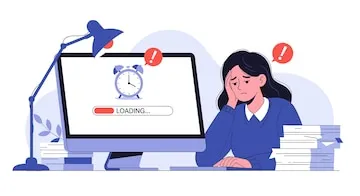
Photo: frustrated person slow computer antivirus loading, via img.freepik.com
There's a particular kind of frustration that every Windows user knows intimately. You sit down to get something done — a work deadline, a quick video edit, maybe just loading a browser tab — and your machine grinds to a halt. The fan spins up like a jet engine preparing for takeoff. Task Manager tells the story: your antivirus is somewhere between 40 and 90 percent of your CPU, doing God knows what in the background. So you do what millions of Americans do every single day. You right-click the tray icon and hit "disable."
Congratulations. You've just made yourself less safe than someone who never installed protection in the first place — because at least they know they're exposed.
This is the antivirus slowdown spiral, and it's one of the most underreported self-inflicted wounds in consumer cybersecurity.
The Numbers Don't Lie (Even If the Vendors Wish They Would)
Independent testing labs have been quietly documenting this performance hit for years. AV-Comparatives, one of the more rigorous outfits doing this kind of work, publishes an annual performance impact report that consistently shows meaningful slowdowns tied to real-time scanning. We're talking about measurable delays in file copying, application launch times, and web browsing — the exact tasks regular people do every hour of every day.
In some test scenarios, popular consumer AV products added anywhere from 15 to 53 percent more time to common operations compared to an unprotected baseline. That's not a rounding error. That's the difference between a machine that feels snappy and one that makes you want to throw it through a window.
And here's the kicker: those tests are run on relatively clean, well-maintained systems. On a three-year-old laptop with a spinning hard drive, a cluttered startup folder, and a handful of background apps — the kind of machine most working Americans are actually using — the slowdown compounds dramatically.
Why Is This Still Happening in 2025?
Fair question. We've had antivirus software since the late 1980s. Processors have gotten astronomically faster. SSDs have replaced spinning disks. Cloud infrastructure has matured. So why does your security software still feel like it was designed to punish you for owning a computer?
The honest answer is a mix of technical complexity and commercial incentives that don't quite align with your interests.
On the technical side, real-time scanning is genuinely hard to do efficiently. Every file that gets touched — opened, moved, downloaded, executed — needs to be inspected. Modern malware is polymorphic, meaning it changes its signature constantly, which forces AV engines to use heuristic and behavioral analysis rather than simple pattern matching. That kind of analysis is computationally expensive. There's no clean shortcut.
But the commercial side is where things get uncomfortable. Antivirus vendors compete heavily on detection rates and feature lists. Adding more scanning layers, more behavioral monitoring, more "AI-powered" threat intelligence modules — all of that looks great in a marketing deck. None of it looks great when your laptop sounds like it's trying to achieve liftoff. Vendors have little incentive to strip features out, even when those features are quietly destroying the user experience.
The Disable Button Is a Security Catastrophe
Here's where this stops being an inconvenience story and starts being a genuine security issue.
Research from security firms and academic institutions has consistently found that a significant chunk of users — estimates range from 20 to 40 percent depending on the study — have disabled or heavily modified their antivirus settings specifically because of performance problems. That's not people who forgot to renew their subscription. That's people who made an active, frustrated choice to trade security for usability.
And you can't really blame them. If your antivirus is making your work laptop unusable during business hours, you're going to turn it off. That's not irresponsibility — that's a completely rational response to a product that's failing you.
The problem is that the moment you disable real-time protection, you're not just slightly less safe. You're operating on a system where malware can execute, persist, and spread without any automated defense. A single bad click — a phishing link, a drive-by download, a malicious email attachment — can compromise everything. And because you turned off the thing that was supposed to catch it, you might not find out for days, weeks, or ever.
Lightweight Alternatives: Real Solution or Marketing Spin?
Vendors aren't completely oblivious to this. The last several years have seen a wave of products marketed specifically as "lightweight" or "low-impact" security solutions. Microsoft's built-in Windows Defender has improved substantially and consistently scores well on performance benchmarks. Some third-party vendors have made genuine engineering investments to reduce their footprint.
But "lightweight" is a relative term, and the marketing often outpaces the reality. A product that's less terrible than its bloated competitors is not the same as a product that doesn't hurt performance. And for users who've been burned by sluggish AV software before, the trust deficit is real. They've heard the "improved performance" pitch before.
There's also a meaningful gap between what power users understand and what average consumers can navigate. Configuring exclusions, scheduling scans for off-hours, adjusting scan sensitivity — all of these can meaningfully reduce performance impact. But expecting your mom to optimize her AV settings is not a cybersecurity strategy. It's wishful thinking.
The Paradox the Industry Refuses to Acknowledge
What makes this whole situation maddening is that the antivirus industry's performance problem actively undermines the industry's core value proposition. You buy security software to be safer. The software makes your computer miserable. You disable the software. You are now less safe than before you bought it, and you've also paid for the privilege.
This isn't a niche edge case. It's a widespread, documented behavioral pattern that security vendors have had decades to address. The fact that it's still a live issue in 2025 suggests that either the problem is harder than it looks, or the financial incentives to solve it aren't strong enough. Probably both.
What's missing is honest, consumer-facing disclosure. Vendors should be required — or at minimum, strongly pressured by the community — to publish standardized, independently verified performance impact data alongside their detection rate statistics. Right now, you can find plenty of numbers about how many threats a product catches. Finding clear data about what it costs your system to catch them is a lot harder.
Until that changes, the slowdown spiral will keep spinning. Users will keep disabling protections. And the security industry will keep selling you the lock while quietly handing the key to your own frustration.
Have you disabled your antivirus because of performance issues? We'd genuinely like to hear about it. Drop your experience in the community forum — this is exactly the kind of real-world data that needs to be part of the conversation.